
A total of over 75 Heads of State and Foreign Ministers will be meeting with Modi, external affairs minister S Jaishankar and minister of state for external affairs V Muraleedharan during the week across various platforms.

The restoration of the Chilahati-Haldibari railway link and signing of the pacts, providing for cooperation in areas of hydrocarbons, agriculture and textiles among others, came at a virtual summit between Prime Minister Narendra Modi and his Bangladeshi counterpart Sheikh Hasina.
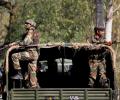
Talking tough in the wake of attack on army camp in Nagrota, India on Thursday made it clear that talks with Pakistan cannot take place in an atmosphere of "continued terror", which it will never accept as "new normal" in the bilateral relationship.
The RBI is scheduled to review its short-term lending rates on Tuesday, amidst apprehensions that it may not go in for interest rate cut even as the pause on the hikes may continue.
The external affairs minister said PM Modi had discussed with his Pakistani counterpart of re-engaging with each other."

"Our government has invariably made efforts to initiate the process of meaningful dialogue and adoption of peaceful means to resolve the issues but unfortunately the expansionist designs of India have remained the main hurdle in this regard," Abbasi said.

The reach of China in other South Asian states has been extraordinary. India's protectionist tendencies have allowed China to don the mantle of regional economic leader. The sooner Indian policy makers realise this and take steps to redress this the better, writes Harsh V Pant
India supports "a fresh SAARC position on Climate Change for COP (Conference of Parties) 16 in accordance with the United Nations Framework Convention on Climate Chnage principles and the Bali Action Plan," External Affairs Minister S M Krishna said, addressing the SAARC Council of Ministers.

India's full membership of the grouping would extend its reach to the Central Asian region in whose peace and stability it is a major stakeholder, says Sana Hashmi.
Terrorism is the biggest threat to South Asia's stability, Prime Minister Manmohan Singh told the South Asian Association for Regional Cooperation summit on Saturday."Terrorists and extremists don't know borders. We must act with determination to fight terrorism. We cannot lose the battle against ideologies of hatred," said Dr Singh.Terrorism is expected to be one of the main topics of discussion during the three-day summit, which started today in Colombo.
Modi will also push for involvement of Indian companies in setting up of ports in that country.
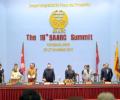
'We have not been able to use the potential of our location in the region and the world and our strength as a nation and an economy to establish an EU-like structure in South Asia,' points out Aakar Patel.

Modi has been wrong in thinking that he can influence people and win friends in Pakistan through his high-octane brand of diplomacy. That is why his Pakistan policy that started off on the high note of saree-and-shawl diplomacy now threatens to end with a whimper with cloak-and-dagger games, says Rajeev Sharma.
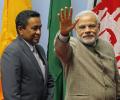
'Now is the time for India, our biggest neighbour and oldest friend, to bring the full array of international policy instruments to bear.'
Pakistan's support for the proposal of establishing the main campus of SAF would be conditional till all issues pertaining to free movement of students, teachers, visiting professors and faculty members are resolved.

India's soft power diplomacy came into play during this cataclysm affecting the world as the pandemic defies barriers and borders, notes Rup Narayan Das.

The proposed South Asia Free Trade Agreement, which will come into effect according to the timetable set out at the SAARC summit in Islamabad, will greatly benefit the region, diplomats from the member countries said in Washington.

When asked if the Indian investigating agency would be allowed to visit Pakistan, Basit said that 'the whole investigation is not about reciprocity in view'.

'From the very start, PM Modi was insistent that visiting foreign leaders should be exposed to an India beyond its capital.' 'Through these experiences, he felt that the full Indian narrative would be much better understood across the world,' explains External Affairs Minister S Jaishankar. A riveting excerpt from Bluekraft Digital Foundation's Modi@20: Dreams Meet Delivery.
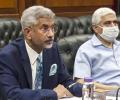
'Terrorism continues to be the overwhelming threat to security and stability in the SCO region and therefore Dr Jaishankar strongly pitched for 'collective action',' observes Dr Rajaram Panda.
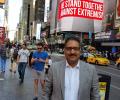
In Shujaat Bukhari, Kashmir has lost a journalist, an activist, ambassador, a formidable voice and, above all, a great human being, mourns Athar Parvaiz.

Modi, who will be addressing the General Debate for the first time in five years, has a packed bilateral and multilateral agenda beginning September 23 till September 27.
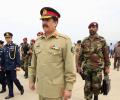
Nawaz Sharif may have permitted the trial of Jaish-e-Mohammed terrorists for the Pathankot attack. But this fell apart because of General Raheel Shareef's keenness to make Kulbhushan Jadhav the centerpiece of global attention. Ambassador G Parthasarthy, a former Indian high commissioner to Pakistan, reveals the Pakistan army chief's gambit against India.

Breaking the logjam in their ties, India and Pakistan on Wednesday announced that they have decided to engage in a "comprehensive" dialogue that will include peace and security and Jammu and Kashmir.

External Affairs Minister Sushma Swaraj on Friday said Pakistan "spoiled the talks" by talking to Hurriyat leaders just ahead of foreign secretaries of the two nations were scheduled to meet in Islamabad last month.

'Pakistan will try to escalate covert operations through terrorism,' says Dr Shalini Chawla.

Just hours after the White House confirmed that United States President Barack Obama would be travelling to India in January, the State Department on Friday announced that it will send a top diplomat to India next week to lay the ground work for the historic presidential visit.
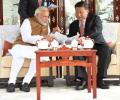
'Till today, we don't know what PM Modi discussed with Xi Jinping and Vladimir Putin, but we have been told that the relations have been reset.' 'We have no evidence from China to show that anything has changed, even though India had made several gestures in preparation for Wuhan,' says Ambassador T P Sreenivasan.
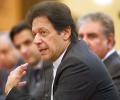
Pak claimed that the Indian Prime Minister's 'internal politics' do not permit him to extend an invitation to his Pakistani counterpart.

Foreign Secretary Aizaz Chaudhry 'condemned the unprovoked firing by' Indian forces on the Line of Control in which two Pakistani soldiers were killed, Pakistan Foreign Office said in a statement.

'The call to isolate Pakistan on the ground of sponsoring and supporting terrorism, particularly when the UN has not even defined terrorism, is a wild goose chase.' 'The responses of the various countries to the Uri attack provides testimony to this fact.' 'No country, not even Russia, was willing to condemn Pakistan for this dastardly act,' says Ambassador T P Sreenivasan.
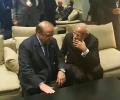
How the two South Asian neighbours will interact with each other in the coming months will be decided by the two prime ministers in Washington.

'The entire Ufa fiasco was predictable and predicted. The Ufa venue had created international interest in the initiative and its failure may have implications for both Pakistan and India. What remains for Modi to do is to produce a prettier rabbit out of his hat next time to deal with the Pakistan imbroglio,' says Ambassador T P Sreenivasan.
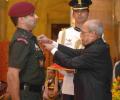
'India showcased its ability to launch multiple Special Forces strikes simultaneously across a well defended front.' 'Through these strikes Pakistan was given a glimpse of the full range of India's military capabilities,' says Brigadier Gurmeet Kanwal (retd).

A five-member Pakistani Joint Investigation Team on Tuesday applied for visa to come to India to carry forward the probe into the Pathankot terror attack, a week after the announcement by Foreign Ministers of the two countries that it will come in New Delhi on March 27.

It is important the SCO focus strongly on economic development and regional integration that leads to greater benefits for the least developed regions of member-countries, writes Sana Hashmi.
'A couple of hours before the H-Hour, the Kupwara division opened small arms and mortar fire on posts opposite its area of operation.' 'This was a diversionary tactic.' 'As Pakistani forces began to react to the firing, special forces teams began to slowly cross the LoC into PoK.' Nitin Gokhale reveals how planning for the surgical strikes began hours after the Uri attack.

The group was indirectly referring to Pakistan PM Nawaz Sharif calling slain Hizbul terrorist Burhan a martyr.
